
What Are Pending Charges? What Families Need to Know

A pending charge is a criminal accusation that has been filed but not yet decided by a court. There has been no conviction and no dismissal. The case is still open. If your loved one was arrested and you are trying to work out where things stand, this is the status they have, whether they are in jail or already home. At GPS Bail Bonds we help Minnesota families with the next practical step, getting the person released while the charges are pending.
TL;DR
- A pending charge means the case is open: the person is accused, not convicted, and the court has not yet reached a final outcome.
- Being released, even “unconditionally,” does not end the case. The person must still go to every court date.
- Release takes different forms: a promise to appear, release with conditions, or release after posting bail or a bond.
- Missing court or breaking a release condition can create new problems on top of the original charge.
- Families can call us 24/7 in Minnesota to talk through bond options, payment structures and co-signer duties before anything is signed.
Table of Contents
- What pending charges actually mean
- How a case becomes pending
- How long can a charge stay pending?
- What “unconditionally released” means
- Release options while charges are pending
- What the person must do while the case is pending
- What families should do first
- Pending charges by type of offense
- Getting released while the charges are pending
- Our perspective
- FAQ
- Sources
What pending charges actually mean
When someone is arrested or cited, the prosecutor decides which charges to file. From that moment until the court enters a final result, the charges are “pending.” A final result can be a dismissal, an acquittal, a plea or a conviction followed by sentencing.
Two points trip families up:
- Pending is not guilty. A charge is an allegation. The person is presumed innocent until a court decides otherwise.
- Pending is not over. The person can be home, working and living normally, and the case is still moving through the court system.
The word also appears in other settings. A “pending charge” on a debit card is a payment that has been authorized but not yet settled. That is a different thing. This article is about criminal cases.
How a case becomes pending
The usual path looks like this:
- Arrest or citation. Police take the person into custody or issue a citation with a court date.
- Booking. The jail records the person’s information and the suspected offense.
- First appearance. A judge tells the person what they are charged with, and decides whether to release them and on what terms. The Illinois Legal Aid Online guide describes this stage as when the judge may also decide on a public defender, set conditions to follow while the case is pending and schedule future court dates. Procedures vary by state, but the shape is similar across the country.
- Later hearings. The case continues with further appearances until it is resolved.
In Minnesota, the court rules on pretrial release are public. Rule 6 of the Minnesota Rules of Criminal Procedure covers conditions of release, and it explains that a release on “personal recognizance” is a release without bail on the defendant’s promise to appear at the proper times.
If your loved one is still in custody and you are not sure where they are held, our Minnesota jail roster and inmate search guide explains how to find them.
How long can a charge stay pending?
There is no single answer. A simple misdemeanor can resolve at one or two hearings. A felony with evidence disputes, lab work or several co-defendants can take many months.
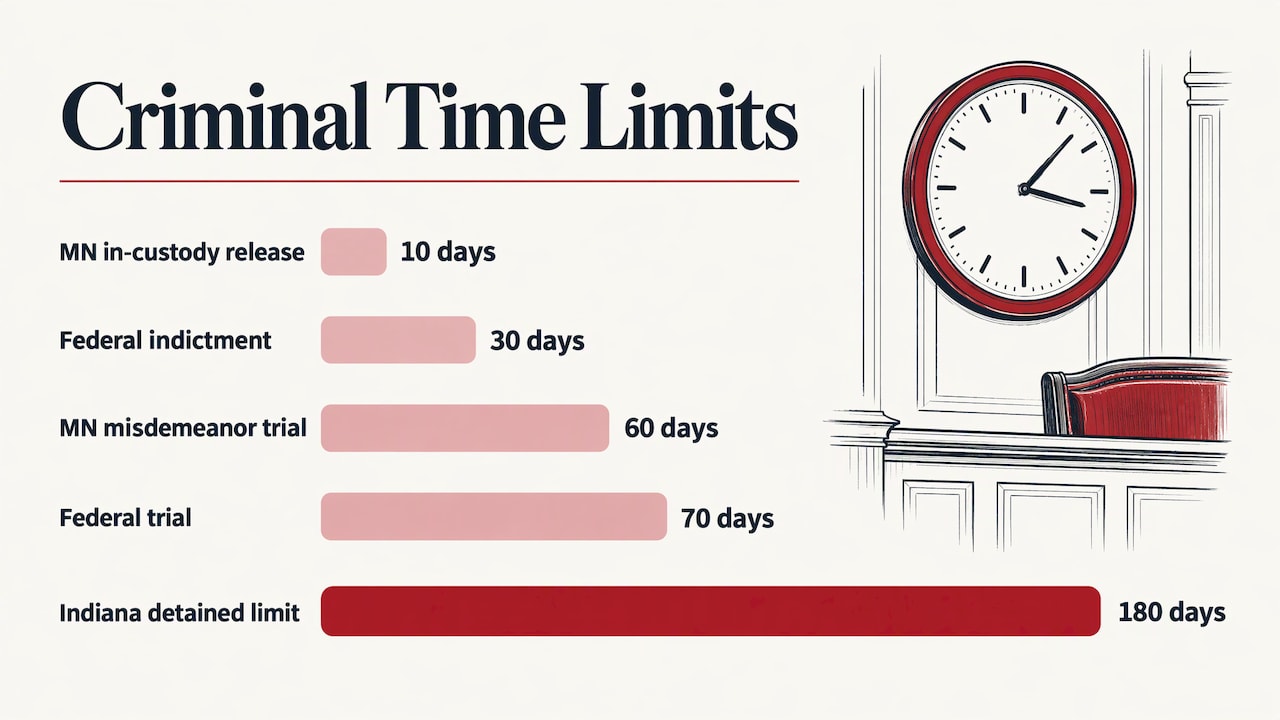
Some rules put outer limits on the wait. Examples, which show how much the rules differ by place:
- In Minnesota misdemeanor cases, the rules provide a 60-day period for trial that starts on the not guilty plea and can be extended for good cause, according to the Minnesota Rules of Criminal Procedure. The same rule says an in-custody defendant whose trial does not begin within ten days must be released subject to nonmonetary conditions.
- In federal court, the Speedy Trial Act generally requires an indictment within 30 days of arrest and trial within 70 days of the indictment or first appearance, with certain “excludable” delays stopping the clock, as the Northern District of Illinois summary of criminal case proceedings explains.
- Indiana, by contrast, has Criminal Rule 4, effective January 1, 2024, which sets a 180-day limit for detained defendants from the later of the charge filing or the arrest.
These are examples, not a promise about any one case. The timing in a particular case depends on the court, the charge and the schedule of the lawyers and the judge. The defendant’s attorney or the court clerk can confirm the actual dates.
What “unconditionally released” means
Families often hear that someone was “released unconditionally” and assume the matter is closed. It usually is not.
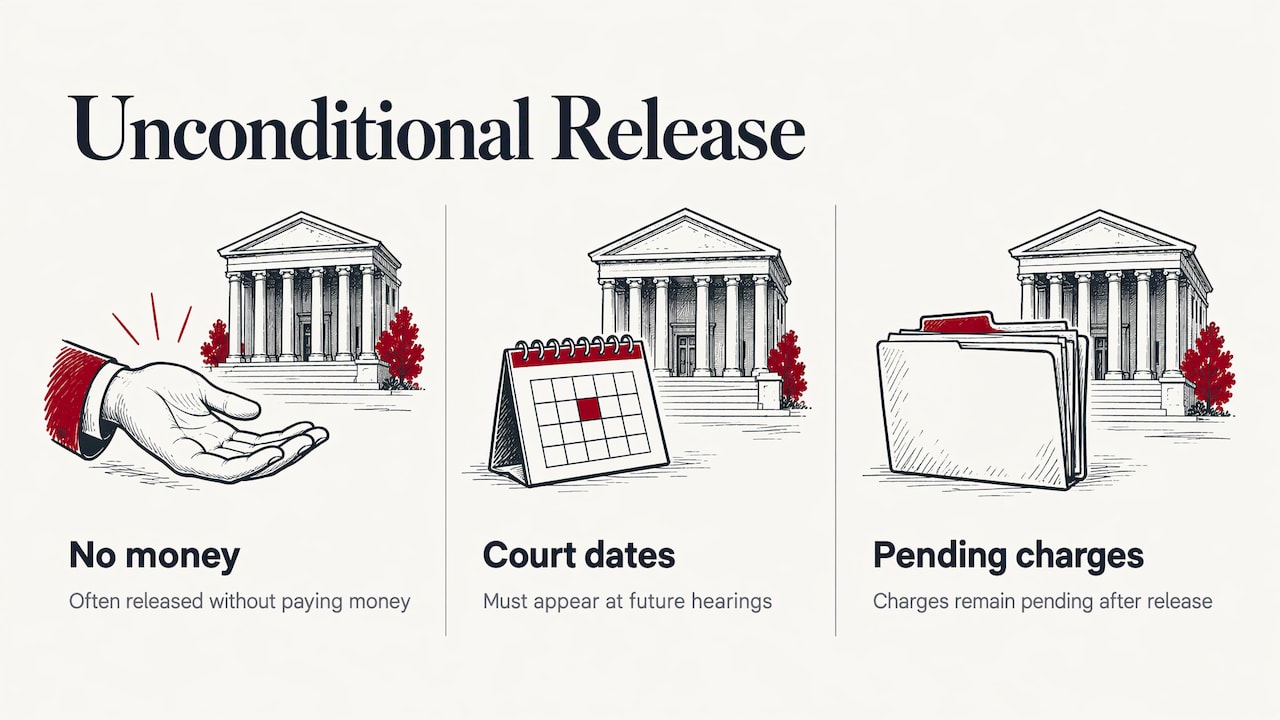
In plain terms, unconditional release means the person is let go without the court attaching extra restrictions, and often without money being paid. It sits at the least restrictive end of release options. Courts in the United States describe a version of it as release on one’s own recognizance. Delaware’s Justice of the Peace Court explains it as release without paying money, though the defendant must sign a document promising to appear at future hearings.
So even the lightest form of release comes with a core obligation: show up to court. The charges stay pending. Canada’s Criminal Law Handbook from the Canadian Judicial Council makes the same point, noting that a release order lists what the person must follow “while your charges are pending” and gives the next appearance date.
The terms “conditional” and “unconditional” are also used in bail practice in Minnesota. Our guide to conditional vs. unconditional bail in MN walks through what each means for a family.
Release options while charges are pending
| Type of release | What it means | What the person must do |
|---|---|---|
| Release on own recognizance (no money) | The court accepts a promise to return | Appear at every hearing |
| Release with conditions | The court sets rules, such as no contact with a named person or check-ins | Follow each condition and appear in court |
| Cash bail | The full bail amount is paid to the court | Appear; the money is tied to that promise |
| Surety bond | A bail bond agent posts a bond for a fee, called a premium | Appear; the co-signer takes on responsibility |
Minnesota’s rules, in Rule 6, say the court must set money bail without other conditions on which the defendant may be released by posting cash or sureties. A “surety” is the party that guarantees the person will return to court. That is the role a bail bond plays.
If you want to understand the vocabulary around this, our short explainer on bail vs. bond covers the difference.
What the person must do while the case is pending
The whole purpose of release is to let someone live at home while the case goes forward. In return, they must hold up their side.
- Go to every court date. If someone misses a hearing, a warrant can be issued. The Canadian handbook notes that failing to attend court while out on bail can lead to a warrant, and breaching conditions can itself be an offense leading to more charges and detention. Minnesota has its own rules, and our page on what happens after a missed court date in Minnesota explains them. You can also read about what bail jumping means.
- Follow every written condition. The Illinois guide says violating release conditions can lead the court to change them or take other action.
- Keep the court and the attorney up to date on a current address and phone number.
- Prepare for the first court date after release. We cover that in what happens at the first court date after bail.
A person with a pending charge may also be asked about it on job or housing applications, and some background checks can show open cases. Whether it appears depends on the check and on the law where it is run. If this affects a job, a lawyer is the right person to ask.
What families should do first
When a call comes in the middle of the night, the order of work matters.
- Find out where the person is held and what the charges are. The jail roster and the booking record show the offense and any bail amount.
- Find out whether bail has been set. At times the amount is set at first appearance; at other times a schedule applies at booking.
- Talk to a defense attorney. The Canadian handbook notes it can be worth taking time to build a strong release plan with a lawyer’s advice, since a well-structured plan raises the likelihood of release. In a Minnesota case, a lawyer can tell you what to expect at the first appearance. A bail agent does not replace legal advice.
- Decide how bail will be handled. If the bail amount is more than the family can pay in cash, a bond is another route.
- Gather what is needed to arrange a bond. Our checklist of what to bring to a bail bondsman lists it.
- Plan the return. After the release, the person needs a ride, a calendar of court dates and a clear sense of the conditions.
For a fuller walkthrough, see the steps families take to get someone out of jail and the explainer on how long release from jail takes.
Pending charges by type of offense
The type of charge shapes the bail discussion. Pages on our site cover the most common ones:
- Misdemeanor bail bonds
- Felony bail bonds
- DWI bail bonds
- Drug charge bail bonds
- Assault bail bonds
- Domestic assault bail bonds
- Probation violation bail bonds
Gun cases have their own considerations, covered in our gun charge bail guide.
Getting released while the charges are pending
If bail has been set and your family wants the person home before the next hearing, we can help in every Minnesota county, any hour. We explain the bond options, the payment structure and what a co-signer agrees to before anything is signed. We also help with locating the inmate and understanding the jail and court procedures. The surety bond premium starts from $100, one-off, as listed on our felony bail bonds page. Payment plans are available too.

To see how a bond amount could translate into a premium, try our Minnesota bail bond calculator. When you are ready to start, go to GPS Bail Bonds and tell us the person’s name and the jail.
Our perspective
Over 40 years of working with Minnesota families, one pattern has stayed the same: the hardest part is not the paperwork, it is not knowing what is happening. A family hears “pending charges” and does not know whether it is good, bad or final.
Our view is that the case is open, and the person’s freedom while it is open depends on what happens in the first hours. That is why we explain the bond options, the payment structure and the co-signer’s obligations upfront, in plain words, before you commit.
We stay in contact with local jails, so we help families work through the practical hurdles of release, and we answer the phone around the clock because arrests do not follow office hours.
The goal is simple: the person comes home, makes every court date, and the family goes through the case with fewer surprises.
Blog
FAQ
Does a pending charge mean someone is guilty?
No. A pending charge is an accusation that has not been decided. The person is presumed innocent until a court rules otherwise. The case can still end in a dismissal, an acquittal, a plea or a conviction.
If someone is released unconditionally, are the charges dropped?
No. Release only decides where the person waits while the case goes forward. Even a release on a simple promise to appear requires the person to attend later hearings, as Delaware’s court guidance explains. The charges remain pending until the court resolves them.
Do pending charges show up on a background check?
They can. Whether an open case appears depends on the type of check and on the law where it is run. For a specific job or housing issue, ask your attorney what applies.
Can a person with pending charges bail out before trial?
In most cases yes. Minnesota’s constitution makes people bailable by sufficient sureties for offenses, as the notes to Rule 6 explain. Bail can be paid in cash or through a surety bond. Call us any hour and we will go through the options for your county.
Sources
- Minnesota Rules of Criminal Procedure, Rule 6, Pretrial Release
- Justice of the Peace Court, Information for Defendants (Delaware Courts)
- Criminal Law Handbook (Canadian Judicial Council, 2021)
- Dealing with a criminal charge (Illinois Legal Aid Online)
- Summary of Criminal Case Proceedings (U.S. District Court, Northern District of Illinois)
- Indiana Criminal Rule 4, Impact of Delay in Criminal Trials