
Domestic Violence Bond Conditions: What Families Need to Know

When someone is arrested on a domestic violence charge, getting them out of jail is only the first step. The release usually comes with court-ordered conditions: no contact with the alleged victim, staying away from the home, no weapons, no alcohol. Break one, and the person can go back to jail. In Minnesota, a bail bond agent who explains those conditions before a bond is posted spares a family the worst surprises, and that is what we do at GPS Bail Bonds for domestic assault charges, 24 hours a day.
TL;DR
- A judge can attach conditions to release in a domestic violence case. In Minnesota the list in Minnesota Statutes section 629.72 includes no contact, staying away from the victim’s home, no firearms and no alcohol or controlled substances.
- Conditions often apply even if the alleged victim says they want contact. They are court orders, not private agreements.
- Violating a condition can lead to arrest, revoked release and forfeited bail.
- Before anyone posts bond, read the written release order line by line, including where the person can live.
- Rules on hold periods and who sets bond differ by state. This article focuses on Minnesota.
Table of Contents
- What domestic violence bond conditions are
- How release works in Minnesota
- Typical conditions a judge can set
- No-contact orders beyond the bond
- What happens after a violation
- What to check before anyone posts bond
- How much does a bond cost?
- Getting help with a bond tonight
- FAQ
- Sources
What domestic violence bond conditions are
Bond conditions are rules a court attaches to a person’s release while the criminal case is pending. They have two goals: protect the alleged victim or family, and make sure the person returns to court. Bail is the money or bond that secures the person’s appearance. Conditions are the behavior rules that come with it. They are separate things, and a family can pay bail correctly and still cause a problem if no one reads the conditions.
They end with the case. According to Massachusetts Legal Help, bail conditions are part of the criminal case and go away when it ends, unlike a separate restraining order. Check how this works in your state, since a protective order can run alongside the bond.
How release works in Minnesota
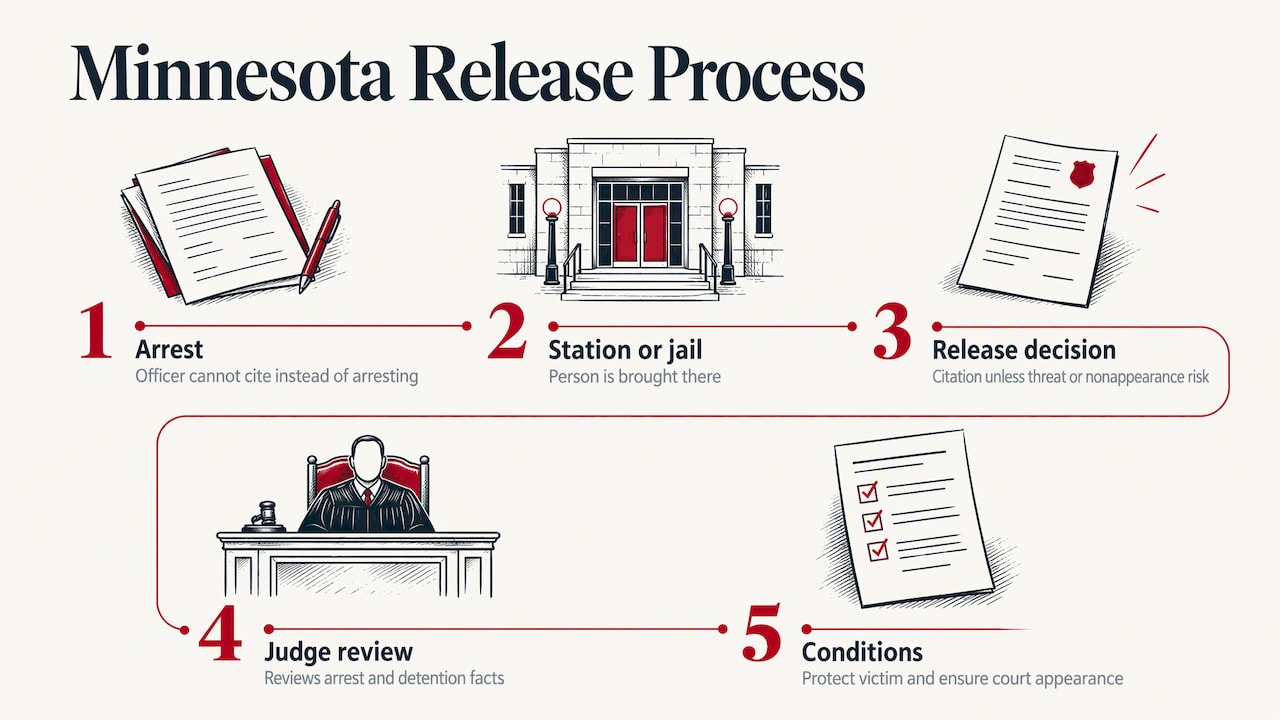
Under Minnesota Statutes section 629.72, an officer cannot simply issue a citation instead of arresting someone for domestic abuse. The person is brought to a police station or county jail. From there, the officer in charge or sheriff must issue a citation in place of continued detention unless release appears to pose a threat to the alleged victim, another family or household member, or public safety, or there is a substantial likelihood the person will not appear in court.
If the person is brought before a judge, the judge reviews the facts of the arrest and detention. The prosecutor presents relevant information, including the account of the victim or family. The judge weighs the threat and the risk of missing court, makes findings on the record where possible, and may set conditions to protect the alleged victim and ensure appearance.
For families, the practical point is timing. The person may sit in jail until that first review, and the conditions set there decide what life looks like after release. Our guide to the Minnesota criminal court process walks through the stages from arrest to resolution.
Typical conditions a judge can set
Minnesota’s statute lets a judge impose release or bail conditions that include:
- Enjoining further domestic abuse or stalking.
- Prohibiting harassing, telephoning, contacting or communicating with the victim, directly or indirectly.
- Ordering the person to vacate or stay away from the victim’s home and any other place the victim is likely to be.
- Prohibiting possession of a firearm or other specified weapon.
- Prohibiting possession or consumption of alcohol or controlled substances.
- Any other matter needed to protect the victim and ensure appearance.
Other states use similar lists. Florida’s 2026 domestic violence benchbook for judges adds random alcohol and drug testing, geographic limits, counseling, electronic monitoring and home detention as options. Those are Florida examples, not Minnesota rules, but they show how far a judge’s discretion can reach.
What “no contact” really covers
This is where families get caught. No contact normally means more than avoiding the person face to face. It includes phone calls, texts, email and social media, and it includes passing messages through friends or relatives. Florida’s benchbook describes it as covering communication through third parties and, in that state, staying within 500 feet of the victim’s residence, vehicle or workplace.
A relative who says “she wants to talk to him, I’ll just pass along a note” can create a violation for the person released. If you are the one helping, never act as the go-between unless the order allows it in writing.
Shared homes and children
Many domestic cases involve people who live together or share children. A stay-away condition can mean the released person cannot go home, even to collect belongings. Plan a different place to stay before release. A parent may also be limited in seeing children. Canada’s Department of Justice best-practices report notes that blanket no-contact terms can complicate parallel family court matters and recommends wording that allows contact through an agreed third party or under a family court order. In Minnesota, if the order does not address children, ask the court to clarify rather than guess.
No-contact orders beyond the bond
Under section 629.72(d), when no contact is a release condition, a Minnesota judge may also issue an ex parte temporary restraining order or temporary order for protection. Ex parte means the judge acts after hearing from one side only. That order lasts until the person is convicted or acquitted or the charge is dismissed, and on the defendant’s request a full hearing must be held within seven days.
So the person may be bound by two documents at once, each with its own terms. Read both.
What happens after a violation
A violation is not a technicality. State details differ, but the pattern is consistent. In Michigan, the courts’ benchbook says an officer may arrest without a warrant, the court may revoke release and declare the bail or surety bond forfeited, and the person may face contempt. In Nebraska, Douglas County prosecutors say a violation can bring an additional charge and a bond revocation or increase.
For a family that paid a bail bond premium, the lesson is plain: a revoked release means the person is back in custody and the process starts again. Keeping the conditions is the cheapest protection a family has.
The pending period is also taken seriously by courts. North Carolina’s best-practices guide for judges describes the time right after release as a known dangerous period for the victim, which is why judges are urged to write conditions out in full and give the defendant a copy with the penalties.
What to check before anyone posts bond
Use this list at the jail, on the phone, or at the kitchen table.
- Get the written conditions. Not a verbal summary. Every line, with the case number.
- Check the address. Where can the person live? Is the family home off limits?
- Check contact rules. Does it cover calls, texts, social media and third parties? Are there exceptions for children?
- Check weapons. If the person owns firearms, a prohibition means someone has to deal with them lawfully. Ask the court or the person’s attorney how.
- Check alcohol and drug terms. Some orders require testing.
- Note the next court date. Missing it is a separate problem from any condition.
- Know who is on the paperwork. A co-signer is responsible for making sure the person returns to court.
If conditions look unworkable, for example the person has nowhere else to live, the defense attorney can ask the court to modify them. Our bail reduction and modification guide explains how requests to change bail work in Minnesota.
How much does a bond cost?
The cost of a bail bond is a fee, the premium, paid to the bond agent, not the full bail amount. We list our surety bond premium as starting from $100, one-off. What a particular case costs depends on the bail the court sets and the bond type, so use our bail bond calculator for an estimate. Courts may also set bail as conditional or unconditional, which changes what the person must agree to; see conditional vs. unconditional bail.
Our view
Families call us at the worst hour, and the most common mistake we want them to avoid is treating release as the end. In a domestic case, release is where the rules begin. We explain bond options, payment structures and co-signer obligations upfront, and we help families understand what the jail and court require, so the person coming home and everyone around them know the terms before the bond is posted.
We assist with every Minnesota county, around the clock, on misdemeanor, felony and domestic assault charges. Our aim is that a family never has to learn a condition by breaking it.
Blog
Getting help with a bond tonight
If someone you love has been arrested in Minnesota, we can explain the bond, the payment plan and the co-signer’s role, and help you locate the person in jail. Start with our domestic assault bail bonds page or reach us through GPS Bail Bonds, any hour.

If the charge is an assault without a domestic element, see assault bail bonds. If the person is on probation, our page on probation violation bail bonds applies.
FAQ
Can the alleged victim cancel a no-contact condition?
No. It is a court order, and only the judge can change it. In Massachusetts, a judge can order no-contact and stay-away conditions without the victim asking. Minnesota’s section 629.72 gives the judge the power to set them to protect the victim and ensure appearance. If both sides want it changed, the defense attorney can ask the court.
How long do the conditions last?
Bond conditions generally last as long as the criminal case, and end when it is resolved. A temporary order for protection issued under Minnesota section 629.72(d) lasts until conviction, acquittal or dismissal, though the defendant may request a hearing within seven days.
Are the rules the same in every state?
No. For example, North Carolina requires a judge, not a magistrate, to set conditions within 48 hours of arrest in covered cases, and Florida’s benchbook states there is no bond until first appearance. This article describes Minnesota’s statute.
Does the family get the bond money back?
The bond premium paid to a bond agent is the agent’s fee. Ask about payment terms and co-signer duties before signing. Our team explains these upfront.
Sources
- Minnesota Statutes 2025, section 629.72
- Minnesota Statutes 2025, section 629.72 (citation and release provisions)
- Florida Courts, Domestic Violence Benchbook 2026
- Massachusetts Legal Help, What happens at the arraignment?
- Michigan Courts, Domestic Violence Benchbook, Pretrial Release
- Douglas County Attorney, Domestic Violence FAQ
- North Carolina Domestic Violence Best Practices Guide for Judges
- UNC School of Government, Pretrial Release in Criminal Domestic Violence Cases
- Canada Department of Justice, Arrest and Bail best practices